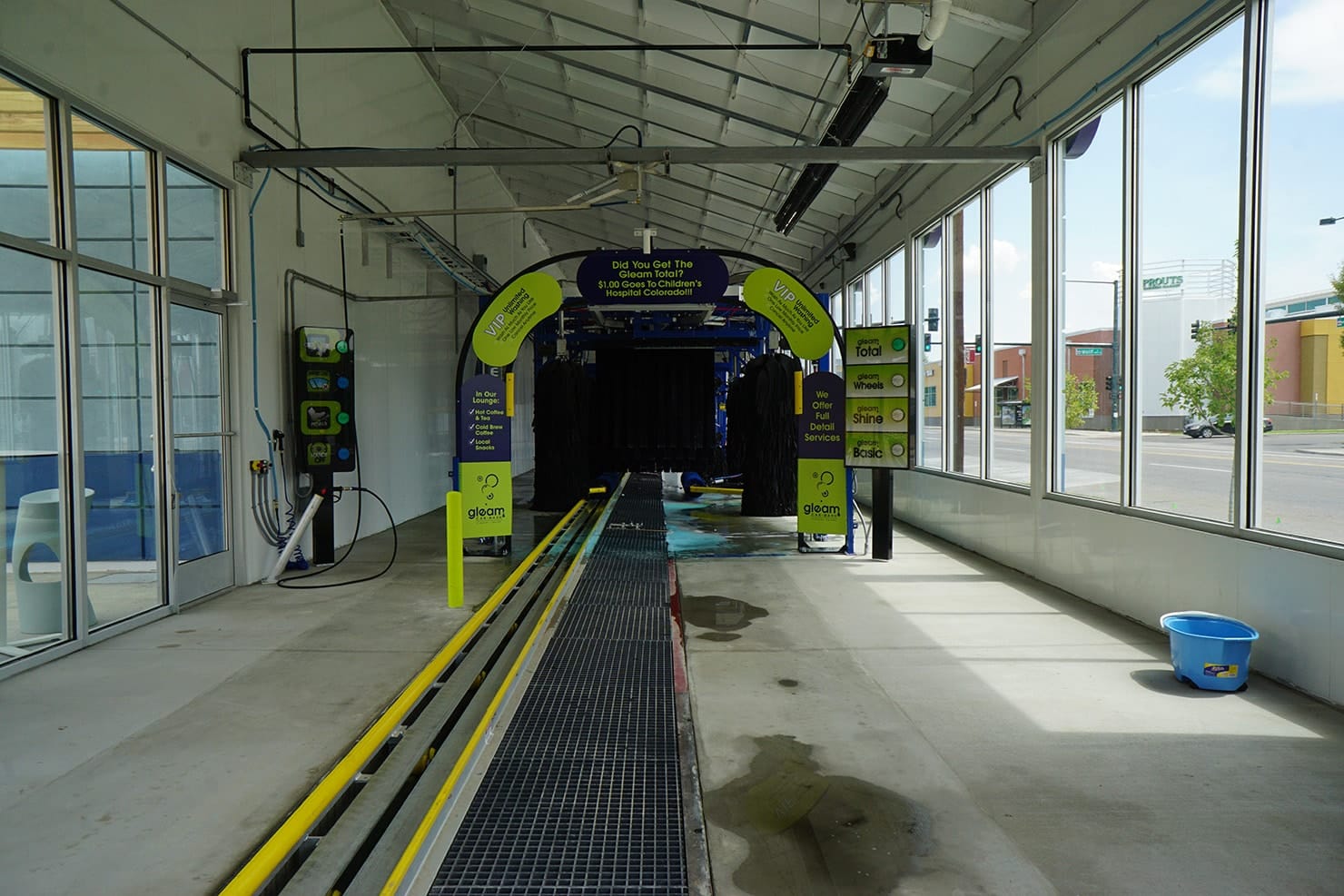
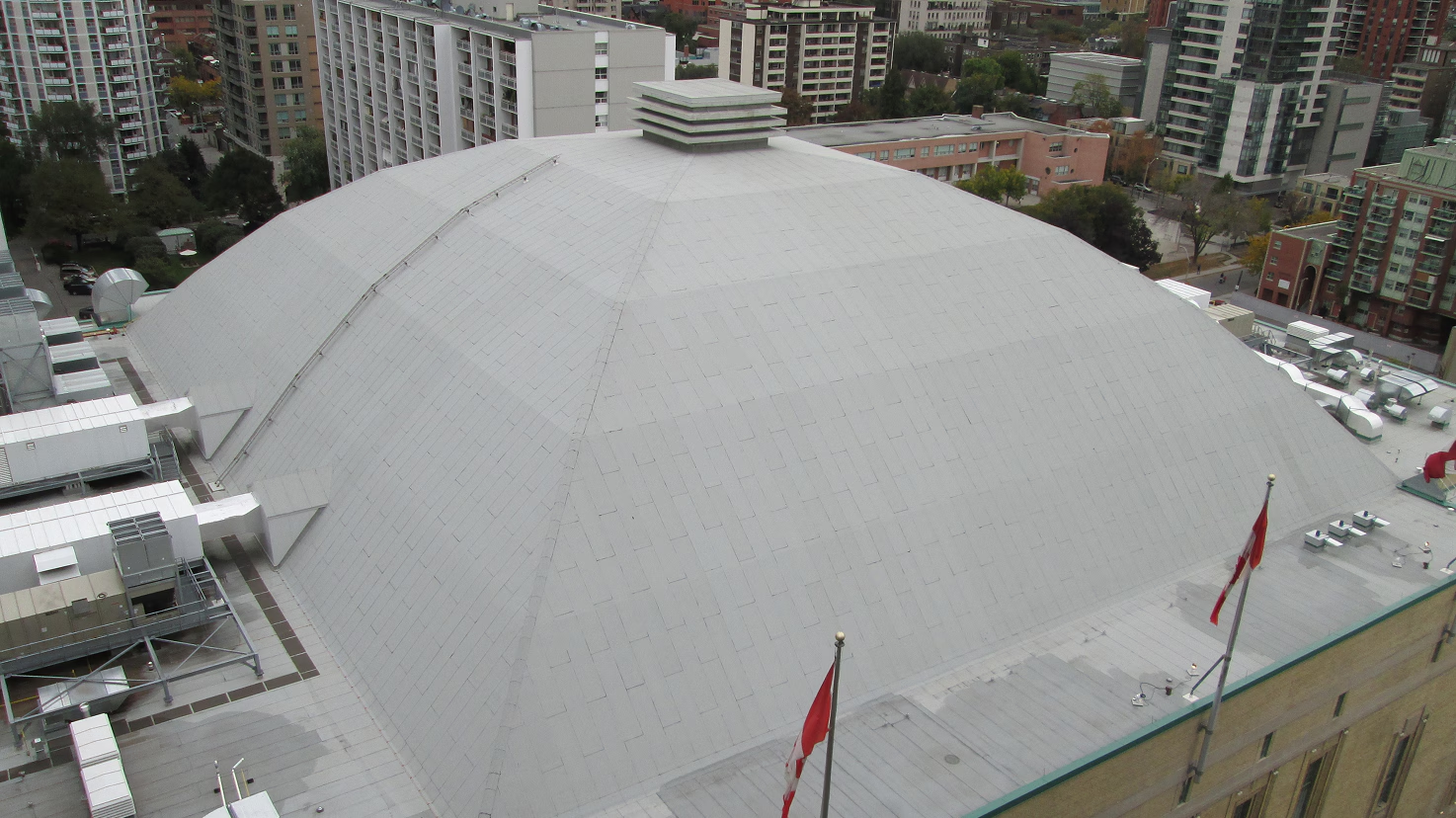
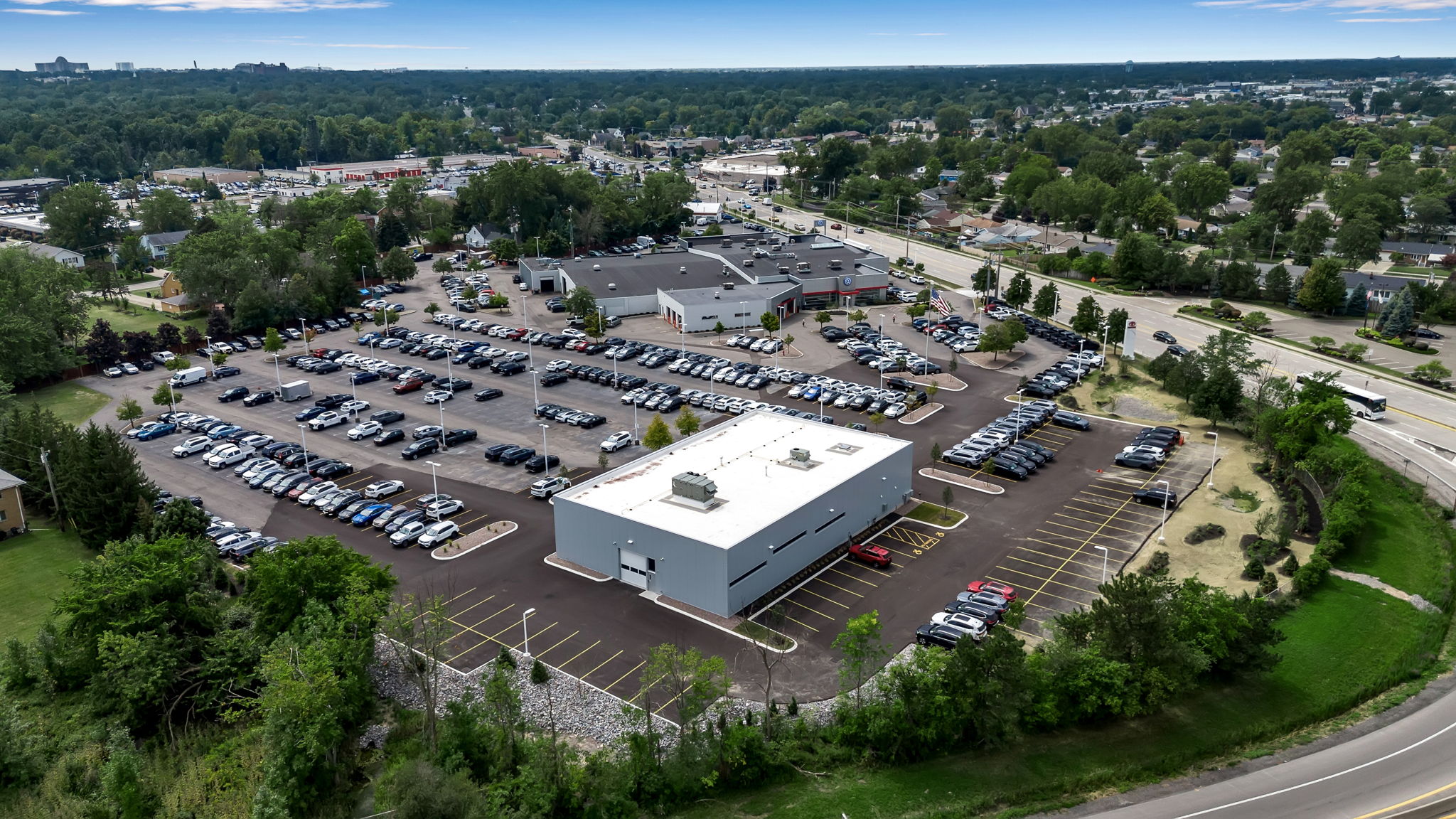
Most commercial roofs in Portland wear out from the top down — UV, rain, and ponding work the membrane until it gives. A car wash roof is different. It is attacked from below. Every wash cycle fills the tunnel with warm, saturated air carrying detergent mist, acid presoak, tire-shine solvent, and dissolved wax. That vapor rises, hits the underside of the deck, and condenses on cold steel. Fasteners corrode from the back side, the deck rusts where you can't see it, and insulation absorbs moisture long before a single drop reaches the floor. By the time a tunnel operator on Powell or 82nd Avenue notices a stain, the assembly has usually been deteriorating for years. We approach car wash roofing as a moisture-and-chemistry problem first and a weatherproofing problem second.
Portland gives car washes plenty of business. The arterials that carry the most daily traffic — 82nd Avenue, Powell Boulevard, Sandy Boulevard, TV Highway out toward Beaverton, and the McLoughlin corridor in Milwaukie — are lined with express tunnels and in-bay automatics, and the wet eight-month rainy season keeps them running hard. That demand is exactly what makes the roof work so unforgiving: there is rarely a slow week to take a tunnel offline, and the same rain that fills the bays also tests every flashing on the building.
The chemical program is the single most important input into a car wash roof specification, and it is the one most contractors ignore. Express tunnels run alkaline detergents, low-pH presoaks, and synthetic wax and drying agents. Those compounds aerosolize, and the exhaust fans pull them straight up through roof penetrations and onto the membrane surface. Most single-ply manufacturers specifically exclude chemical exposure from their standard warranties, so a roof that looks correct on paper can be voided the day it is installed.
We separate the building into chemical zones before we quote anything:
Before we name a membrane for the tunnel, we ask the operator which chemical line they run and confirm compatibility directly with the manufacturer's chemical-resistance data. If a chemical-exposure warranty endorsement is available for that product, we pursue it rather than relying on a standard warranty that excludes the very condition the roof lives in.
A car wash deck stays warm and wet on its underside while Portland air sits cold and damp for much of the year. That temperature split drives moisture into the assembly. Without a proper vapor retarder under the insulation, condensation forms inside the roof, soaks the insulation, and corrodes the deck from behind — exactly the hidden failure mode that ends roofs early. On tunnel and bay sections we design the assembly with a vapor retarder matched to the interior humidity load, and we detail the insulation so the temperature gradient never lets the dew point land on the steel deck. This is the difference between a tunnel roof that lasts and one that quietly rots while passing every surface inspection.
Car washes run high-volume exhaust to clear steam and chemical vapor from the tunnel, and those fans punch large, hard-working penetrations through the roof. A standard HVAC curb detail does not survive here — the continuous airflow, heat, and corrosive condensate demand oversized curbs, welded PVC flashings, and stainless or coated hardware. We inspect every penetration as its own item: exhaust fans, blower stacks, reclaim vents, conduit, and the original roof drains, which on older Portland tunnels are frequently undersized for the water the building actually moves.
The vacuum canopy on the exit side is its own roof, and it fails for its own reasons. It catches vehicle exhaust, overspray from tire dressing, and the full force of Portland's wind-driven rain, and it is usually a light metal or EPDM-clad structure. The most reliable leak on an express wash is not the tunnel at all — it is the canopy-to-building transition and the canopy's internal gutter and downspout connections, where two structures move independently and the flashing gets neglected. We treat canopy membrane or panel replacement, canopy gutters, and every canopy-to-building joint as part of the roofing scope, not an afterthought.